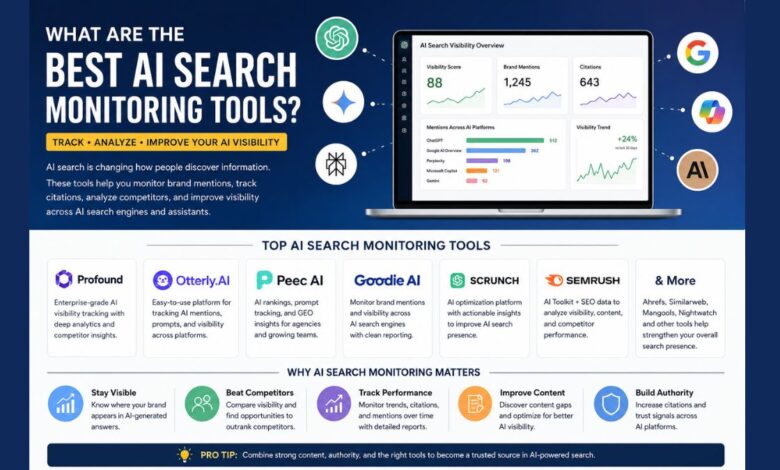
AI search monitoring tools are software platforms designed to measure and analyze how brands, websites, products, and content appear inside AI-powered search experiences.
Unlike traditional SEO tools that focus on keyword rankings in search engines, AI monitoring tools analyze answers generated by large language models (LLMs) and AI search platforms.
For example, these tools can help answer questions like:
- Does ChatGPT recommend my business?
- Is my website cited in Google AI Overviews?
- Which competitors appear more often in AI-generated answers?
- How frequently is my brand mentioned across AI search platforms?
- Which prompts trigger mentions of my products or services?
Instead of tracking only search rankings, AI monitoring focuses on visibility inside conversational search experiences.
Why AI Search Monitoring Matters
Search behavior has changed dramatically over the past few years. Many users now prefer asking AI assistants rather than typing short keywords into a search engine.
Imagine you own an online travel agency.
A customer asks an AI assistant:
“What are the best family vacation destinations in Europe?”
If the AI recommends your website as a trusted source, you’ve gained valuable exposure. If it recommends your competitors instead, you’ve lost an opportunity before the customer even opens a browser tab.
Monitoring AI search visibility helps businesses understand how AI systems perceive their content and whether their authority is improving over time.
Some key benefits include:
- Tracking AI-generated brand mentions
- Monitoring competitor visibility
- Measuring citation frequency
- Identifying content gaps
- Improving Answer Engine Optimization (AEO)
- Supporting Generative Engine Optimization (GEO)
- Discovering new traffic opportunities
As AI-generated answers become more common, monitoring them becomes just as important as monitoring traditional search rankings.
AI Search Monitoring vs Traditional SEO Tools
Although both types of tools aim to improve online visibility, they focus on different aspects of search.
| Traditional SEO Tools | AI Search Monitoring Tools |
|---|---|
| Track Google rankings | Track AI-generated answers |
| Monitor backlinks | Monitor AI citations |
| Analyze keywords | Analyze prompts |
| Measure organic traffic | Measure AI visibility |
| Focus on search engines | Focus on AI assistants |
| Optimize SERPs | Optimize AI recommendations |
Many businesses now use both types together because they complement one another rather than compete.
Features to Look for in an AI Search Monitoring Tool
Not every platform offers the same capabilities. Choosing the right tool depends on your goals, budget, and business size.
Here are the most valuable features to consider.
Multi-Platform AI Tracking
A quality tool should monitor multiple AI search platforms instead of only one.
Look for coverage of:
- ChatGPT
- Google AI Overviews
- Google AI Mode (where available)
- Perplexity
- Microsoft Copilot
- Gemini
- Claude
- Brave Search AI
The broader the coverage, the better your understanding of your overall AI visibility.
Brand Mention Monitoring
One of the biggest advantages of AI monitoring is seeing exactly when and where your brand appears.
This helps you discover:
- Positive mentions
- Missing opportunities
- Incorrect information
- Competitor comparisons
Monitoring mentions regularly allows you to respond quickly if your visibility changes.
Citation Tracking
AI systems frequently reference trusted websites when generating answers.
Citation tracking shows:
- Which pages AI models reference
- How often your content is cited
- Which competitors receive more citations
- Opportunities to improve authority
Strong citations usually indicate that your content is considered reliable.
Prompt Tracking
Users ask AI assistants questions in many different ways.
Prompt tracking lets you test hundreds or even thousands of questions to see whether your business appears in the responses.
This information is valuable for improving your content strategy.
Competitor Analysis
Good AI monitoring platforms also reveal:
- Which competitors dominate AI answers
- Which brands are gaining visibility
- Topics competitors own
- Opportunities to outperform them
Instead of guessing what works, you can base your strategy on real data.
Reporting and Dashboards
Clear reports save time.
Look for dashboards that include:
- Visibility scores
- Historical trends
- Brand mentions
- AI citations
- Competitor comparisons
- Exportable reports
Marketing teams often rely on these reports to demonstrate progress to clients or stakeholders.
The Best AI Search Monitoring Tools in 2026
The AI search monitoring market is growing rapidly. While new platforms appear regularly, a handful have established themselves as trusted solutions.
Below are some of the strongest options available today.
Profound
Profound is widely recognized as one of the leading enterprise AI search monitoring platforms.
It helps organizations understand how their brands appear across multiple AI search engines while offering detailed visibility reports and competitor analysis.
Best For
- Enterprise companies
- Large brands
- Marketing teams
- Global businesses
Key Features
- AI visibility tracking
- Prompt monitoring
- Citation analysis
- Brand monitoring
- Competitor benchmarking
- Enterprise reporting
- Historical trend analysis
Pros
- Powerful analytics
- Extensive AI coverage
- Excellent reporting
- Scalable for large organizations
Cons
- Premium pricing
- May be more advanced than small businesses need
If your company depends heavily on brand visibility across AI platforms, Profound is one of the strongest enterprise solutions available.
Otterly AI
Otterly AI has become a popular choice among SEO professionals because it focuses specifically on monitoring AI-generated search experiences.
Its dashboard is easy to understand, making it suitable for agencies and smaller marketing teams.
Best For
- SEO agencies
- Consultants
- Small businesses
- Content marketers
Key Features
- AI visibility tracking
- ChatGPT monitoring
- Google AI Overview tracking
- Prompt testing
- Scheduled reports
- Performance history
Pros
- Beginner-friendly interface
- Affordable pricing
- Fast reporting
- Useful trend analysis
Cons
- Fewer enterprise features than larger competitors
For businesses entering AI search optimization, Otterly AI offers an excellent balance of functionality and simplicity.
Peec AI
Peec AI focuses on helping businesses improve their visibility inside AI-generated search results.
Rather than simply reporting data, it also provides insights into how content can be optimized for better AI exposure.
Best For
- Digital agencies
- SEO teams
- Growing companies
Key Features
- AI ranking analysis
- Prompt tracking
- Visibility scoring
- Competitor comparison
- GEO insights
- Performance reporting
Pros
- Actionable recommendations
- Modern dashboard
- Strong competitor analysis
Cons
- Smaller ecosystem than older SEO platforms
Peec AI is particularly useful for businesses actively investing in Generative Engine Optimization (GEO).
Goodie AI
Goodie AI emphasizes brand monitoring across AI-powered search experiences.
Instead of focusing only on rankings, it helps companies understand how AI assistants describe their products and services.
Best For
- Marketing teams
- Brand managers
- Agencies
Key Features
- Brand mention tracking
- Prompt monitoring
- AI analytics
- Competitor visibility
- Historical reports
Pros
- Strong brand monitoring
- Easy reporting
- Clean interface
Cons
- Advanced enterprise integrations are limited
Businesses that prioritize reputation and brand awareness will appreciate Goodie AI’s monitoring capabilities.
Scrunch AI
Scrunch AI is designed for organizations that want deeper insights into AI search performance and content optimization.
Beyond monitoring, it offers recommendations for improving how AI systems understand and present your content.
Best For
- Enterprise SEO teams
- Large publishers
- Content-driven businesses
Key Features
- AI visibility tracking
- Prompt analysis
- Content recommendations
- Competitor intelligence
- Brand monitoring
- AI optimization insights
Pros
- Comprehensive analytics
- Helpful optimization suggestions
- Enterprise-ready features
Cons
- Higher learning curve
- Pricing may not suit smaller businesses
For companies serious about long-term AI search performance, Scrunch AI provides both monitoring and strategic guidance.
Semrush AI Toolkit
Semrush has long been a trusted name in SEO, and its AI-focused capabilities are helping businesses adapt to the changing search landscape. While it remains a complete digital marketing platform, its AI Toolkit provides insights into how brands appear in AI-generated experiences and how AI-driven traffic is evolving.
Best For
- Existing Semrush users
- Marketing agencies
- Content teams
- Mid-sized businesses
Key Features
- AI visibility insights
- Competitor research
- Keyword intelligence
- Content optimization recommendations
- Domain analysis
- Traffic reporting
Pros
- Combines traditional SEO with AI insights
- Familiar interface for existing users
- Excellent content research tools
Cons
- AI monitoring is one part of a larger SEO platform
- Premium plans can be expensive
If you’re already using Semrush, its AI capabilities provide a convenient way to expand your SEO strategy without switching to another platform.
Ahrefs
Ahrefs is another leading SEO platform that has adapted to the rise of AI-powered search. While it isn’t a dedicated AI search monitoring tool, it offers valuable data for understanding content performance, backlinks, and emerging AI-driven traffic opportunities.
Best For
- SEO professionals
- Bloggers
- Publishers
- Digital marketers
Key Features
- Keyword research
- Backlink analysis
- Content Explorer
- Site audits
- Competitive research
- Organic traffic monitoring
Pros
- Industry-leading backlink database
- Excellent keyword data
- Strong competitor analysis
Cons
- Limited dedicated AI visibility tracking
- Best used alongside a specialized AI monitoring platform
Ahrefs remains an excellent choice for strengthening the authority signals that AI systems often rely on when selecting trusted sources.
Similarweb
Similarweb focuses on digital intelligence rather than traditional SEO alone. It provides market insights, competitor benchmarking, and referral traffic analysis that can help businesses understand the growing influence of AI platforms.
Best For
- Enterprise businesses
- Market researchers
- Growth teams
Key Features
- Traffic analysis
- Industry benchmarking
- Competitor intelligence
- Referral source tracking
- Audience insights
Pros
- Excellent competitive intelligence
- Reliable market data
- Strong reporting capabilities
Cons
- Not a dedicated AI monitoring solution
- Higher pricing for advanced features
Businesses looking for a broader view of digital performance often combine Similarweb with specialized AI monitoring software.
Mangools
Mangools is known for making SEO simple and affordable. Although it doesn’t specialize in AI monitoring, its keyword research and rank tracking tools support content strategies that improve visibility across both traditional and AI-powered search.
Best For
- Freelancers
- Bloggers
- Small businesses
Key Features
- Keyword research
- Rank tracking
- SERP analysis
- Backlink monitoring
- SEO metrics
Pros
- Easy to use
- Affordable pricing
- Clean dashboard
Cons
- No dedicated AI visibility reports
- Limited enterprise functionality
Mangools is an excellent starting point for businesses with smaller budgets that still want to improve overall search performance.
Nightwatch
Nightwatch is a powerful rank-tracking platform designed for agencies and businesses that need detailed reporting. While its primary focus is traditional search rankings, it complements AI search monitoring by helping teams measure the broader impact of SEO improvements.
Best For
- SEO agencies
- Marketing teams
- Growing businesses
Key Features
- Daily rank tracking
- Competitor monitoring
- Local SEO tracking
- Automated reports
- Performance dashboards
Pros
- Highly customizable reports
- Accurate tracking
- Agency-friendly features
Cons
- Not designed specifically for AI-generated answers
- Requires pairing with AI-focused tools for complete coverage
Nightwatch works well for organizations that want to combine traditional ranking data with AI visibility insights.
Comparison of the Best AI Search Monitoring Tools
| Tool | Best For | AI Visibility Tracking | Competitor Analysis | Reporting |
|---|---|---|---|---|
| Profound | Enterprise businesses | Excellent | Excellent | Advanced |
| Otterly AI | Agencies & SMBs | Excellent | Good | Excellent |
| Peec AI | SEO teams | Excellent | Excellent | Very Good |
| Goodie AI | Brand monitoring | Very Good | Good | Very Good |
| Scrunch AI | Large organizations | Excellent | Excellent | Advanced |
| Semrush AI Toolkit | All-in-one marketing | Good | Excellent | Excellent |
| Ahrefs | SEO professionals | Limited | Excellent | Excellent |
| Similarweb | Market intelligence | Moderate | Excellent | Excellent |
| Mangools | Beginners | Limited | Good | Good |
| Nightwatch | Rank tracking | Limited | Good | Excellent |
How to Choose the Right AI Search Monitoring Tool
The best tool depends on your goals, team size, and budget.
For Small Businesses
Look for a platform with a simple dashboard, affordable pricing, and essential features like prompt tracking and AI visibility reports. Otterly AI is often a practical starting point.
For SEO Agencies
Agencies usually need competitor analysis, historical reporting, and client-friendly dashboards. Peec AI and Profound offer advanced reporting capabilities that support multiple clients.
For Enterprise Companies
Large organizations should prioritize scalability, integrations, and detailed analytics. Enterprise-focused platforms like Profound and Scrunch AI are built to handle complex monitoring needs.
For Existing SEO Teams
If your team already relies on platforms such as Semrush or Ahrefs, adding their AI-related features can strengthen your workflow while reducing the need for additional tools.
Practical Example of AI Search Monitoring
Imagine you run an online fitness equipment store.
A customer asks an AI assistant:
“What are the best adjustable dumbbells for a home gym?”
If the AI recommends your product pages, your brand gains valuable exposure.
However, if it consistently recommends competitors, AI monitoring tools can help you identify why. You may discover that competitors have more comprehensive buying guides, stronger authority, or are cited more frequently by trusted sources.
With this information, you can improve your content by adding expert advice, answering common questions, updating product comparisons, and publishing more authoritative resources.
Tips to Improve Your Visibility in AI Search
Monitoring your visibility is only the first step. Improving it requires a strong content strategy.
Here are some practical tips:
Create Helpful Content
Write articles that genuinely answer readers’ questions instead of focusing only on keywords. Clear explanations, practical advice, and original insights make your content more valuable.
Demonstrate Expertise
Include expert opinions, first-hand experience, research, and accurate information. AI systems often favor content that appears trustworthy and well-supported.
Use Clear Headings
Organize articles with logical headings and subheadings. This makes your content easier for both readers and AI systems to understand.
Answer Specific Questions
Include sections that directly answer common user queries. Concise, informative responses are more likely to be referenced in AI-generated answers.
Keep Content Updated
AI search systems tend to prefer fresh and relevant information. Review your articles regularly to ensure statistics, examples, and recommendations remain current.
Build Authority
Earn quality backlinks, publish original research, and establish your website as a reliable source within your industry. Strong authority signals increase the likelihood of being cited by AI systems.
Common Mistakes to Avoid
Many businesses still treat AI search optimization exactly like traditional SEO. Avoid these common mistakes:
- Focusing only on keyword density
- Ignoring user intent
- Publishing thin or duplicate content
- Neglecting regular content updates
- Failing to monitor competitors
- Overlooking AI-generated search experiences
- Relying solely on traditional ranking reports
A balanced strategy that combines SEO, Answer Engine Optimization (AEO), and Generative Engine Optimization (GEO) is becoming increasingly important.
FAQs
What is an AI search monitoring tool?
An AI search monitoring tool tracks how your brand, website, or content appears in AI-powered search engines and conversational assistants. It helps measure visibility, citations, and brand mentions across AI-generated answers.
Why are AI search monitoring tools important?
As more users rely on AI assistants for information, businesses need to understand whether their content is being recommended or overlooked. Monitoring helps identify opportunities to improve visibility and stay competitive.
Can AI search monitoring replace traditional SEO?
No. AI search monitoring complements traditional SEO rather than replacing it. Businesses benefit most by combining strong SEO practices with strategies that improve visibility in AI-generated responses.
Which businesses benefit most from AI search monitoring?
Any organization that depends on online visibility can benefit, including e-commerce stores, publishers, software companies, local businesses, agencies, and enterprise brands.
Are there free AI search monitoring tools?
Some platforms offer free trials or limited plans, but most advanced AI monitoring features are available through paid subscriptions due to the complexity of collecting and analyzing AI search data.
How often should I monitor AI search visibility?
For active marketing campaigns, checking weekly or monthly is a good practice. Businesses in highly competitive industries may benefit from more frequent monitoring.
Conclusion
AI-powered search is reshaping how people discover information online. Instead of relying solely on traditional search results, users increasingly turn to conversational AI platforms for recommendations, answers, and buying advice. As a result, businesses need new ways to measure their digital presence.
The best AI search monitoring tools help you understand where your brand appears, how often you’re cited, and how your visibility compares with competitors. Whether you choose an enterprise platform like Profound, a specialized solution such as Otterly AI or Peec AI, or combine AI monitoring with established SEO platforms like Semrush and Ahrefs, the goal remains the same: make your content easier for both people and AI systems to trust.
The organizations that succeed in the coming years will be those that consistently publish helpful, accurate, and experience-driven content while monitoring how AI search engines present their brand. By combining high-quality content with the right monitoring tools, you’ll be better positioned to earn visibility, authority, and long-term organic growth in the evolving world of AI search.