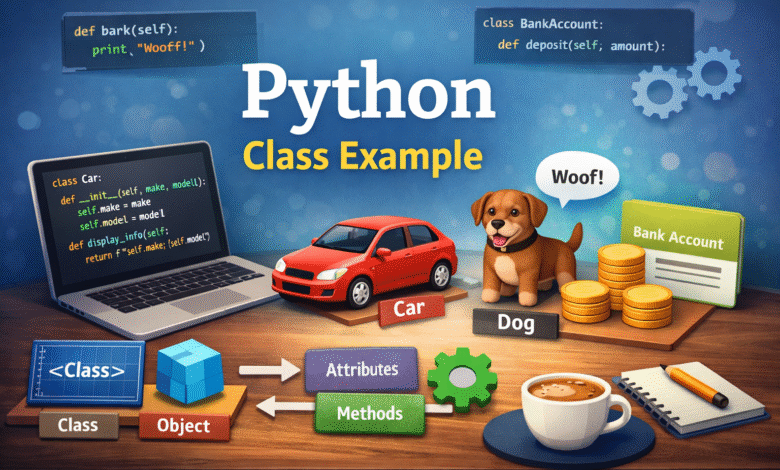
Python is one of the most popular programming languages in the world, known for its simplicity and versatility. One of the core concepts that make Python so powerful is object-oriented programming, which revolves around the use of classes and objects. Understanding Python classes is essential for anyone who wants to write organized, reusable, and efficient code. In this article, we will explore a Python class example in detail, covering everything from basic concepts to advanced usage.
What Is a Class in Python?
A class in Python is essentially a blueprint for creating objects. It defines a set of attributes and methods that the objects created from the class will have. Classes allow programmers to model real-world entities, encapsulate data, and implement functionality in a structured way. Unlike procedural programming, where you write functions and manipulate data independently, classes bring both data and behavior together under one roof.
For instance, consider the idea of a Car. A car has attributes such as color, make, and model, and behaviors like start, stop, or accelerate. In Python, these attributes and behaviors can be represented in a class.
Basic Python Class Example
Let’s start with a simple Python class example to demonstrate how classes work:
class Car:
    def __init__(self, make, model, year):
        self.make = make
        self.model = model
        self.year = year

    def display_info(self):
        return f"{self.year} {self.make} {self.model}"
Here, the Car class has three attributes: make, model, and year, initialized using the constructor method __init__. The method display_info is used to display the details of the car. To use this class, we create an object:
my_car = Car("Toyota", "Corolla", 2023)
print(my_car.display_info())
Output: 2023 Toyota Corolla
This simple Python class example demonstrates how to encapsulate data and behavior, making your code more structured and maintainable.
Understanding the Constructor Method (init)
The __init__ method in Python is a special method called a constructor. It automatically runs when a new object of the class is created. The primary role of the constructor is to initialize instance attributes with values specific to that object. Each object can have unique attribute values, even though it is created from the same class.
For example, if you create multiple car objects:
car1 = Car("Honda", "Civic", 2022)
car2 = Car("Ford", "Mustang", 2021)

print(car1.display_info())  # Output: 2022 Honda Civic
print(car2.display_info())  # Output: 2021 Ford Mustang
Even though both objects belong to the Car class, each object maintains its own set of attribute values.
Class vs Instance Attributes
In Python classes, attributes can be either class attributes or instance attributes. Instance attributes, as seen in the above example, are specific to each object. Class attributes, on the other hand, are shared among all instances of the class.
class Dog:
    species = "Canis lupus familiaris"  # class attribute

    def __init__(self, name, age):
        self.name = name  # instance attribute
        self.age = age
In this Python class example, species is the same for all dogs, whereas name and age vary for each object.
Adding Methods to a Class
Methods in Python classes define the behavior of the objects. A method can access and modify instance attributes, perform calculations, or implement functionality relevant to the object.
class Circle:
    pi = 3.1416

    def __init__(self, radius):
        self.radius = radius

    def area(self):
        return Circle.pi * self.radius ** 2

    def circumference(self):
        return 2 * Circle.pi * self.radius
Here, the Circle class has two methods: area and circumference. By creating a Circle object and calling these methods, you can calculate the area and circumference of any circle.
Inheritance in Python Classes
Inheritance is a fundamental concept in object-oriented programming that allows a class to inherit attributes and methods from another class. This promotes code reuse and makes your program more scalable.
class Vehicle:
    def __init__(self, brand, year):
        self.brand = brand
        self.year = year

    def vehicle_info(self):
        return f"{self.year} {self.brand}"

class Truck(Vehicle):
    def load_capacity(self, capacity):
        return f"Load capacity: {capacity} tons"
Here, Truck inherits from Vehicle and gains access to the vehicle_info method. This Python class example illustrates how inheritance can simplify code by avoiding duplication.
Class Methods and Static Methods
Python provides special decorators for defining class methods and static methods. Class methods affect the class itself, while static methods do not interact with the class or instance attributes.
class Employee:
    total_employees = 0

    def __init__(self, name):
        self.name = name
        Employee.total_employees += 1

    @classmethod
    def get_total_employees(cls):
        return cls.total_employees

    @staticmethod
    def company_policy():
        return "All employees must follow the code of conduct."
Class methods and static methods help organize functionality that belongs logically to a class rather than an individual object.
Real-World Python Class Example
Consider a BankAccount class used in banking applications:
class BankAccount:
    def __init__(self, account_number, balance=0):
        self.account_number = account_number
        self.balance = balance

    def deposit(self, amount):
        self.balance += amount
        return f"Deposited: {amount}, New Balance: {self.balance}"

    def withdraw(self, amount):
        if amount > self.balance:
            return "Insufficient funds"
        self.balance -= amount
        return f"Withdrawn: {amount}, Remaining Balance: {self.balance}"
This Python class example demonstrates how classes can model real-life scenarios with attributes and behaviors that closely resemble actual entities.
Benefits of Using Python Classes
- Encapsulation – Keeps data and functions together in a single unit.
- Code Reusability – Inheritance and reusable methods reduce redundancy.
- Modularity – Classes allow large programs to be organized into logical components.
- Abstraction – Users can interact with objects without worrying about implementation details.
These benefits make Python classes a cornerstone of professional Python development.
Conclusion
Understanding Python classes is crucial for writing structured, efficient, and maintainable code. A Python class example, whether simple like a Car or more complex like a BankAccount, demonstrates how data and behavior can be encapsulated into objects. Mastering classes opens the door to advanced topics like inheritance, polymorphism, and object-oriented design principles. By applying these concepts, developers can create programs that are not only functional but also scalable and easy to maintain.
Frequently Asked Questions (FAQs)
1. What is a Python class example?
A Python class example is a sample code demonstrating how to define a class, its attributes, and methods.
2. How do I create an object from a class?
You create an object by calling the class with required arguments, like obj = ClassName(args).
3. What is the purpose of the __init__ method?
The __init__ method initializes instance attributes when an object is created.
4. Can a Python class have both class and instance attributes?
Yes, class attributes are shared among all objects, while instance attributes are unique to each object.
5. How does inheritance work in Python classes?
Inheritance allows a class to reuse attributes and methods from a parent class, reducing code duplication.